
Quick story. A student comes to us with a good profile, a solid course, money in the bank. Still gets a request for more information. The reason? His father’s name was on the bank statement and nobody explained it. That’s it. One missing sentence.
This is what most document problems look like. Rarely a big missing piece. Usually two papers that don’t quite agree.
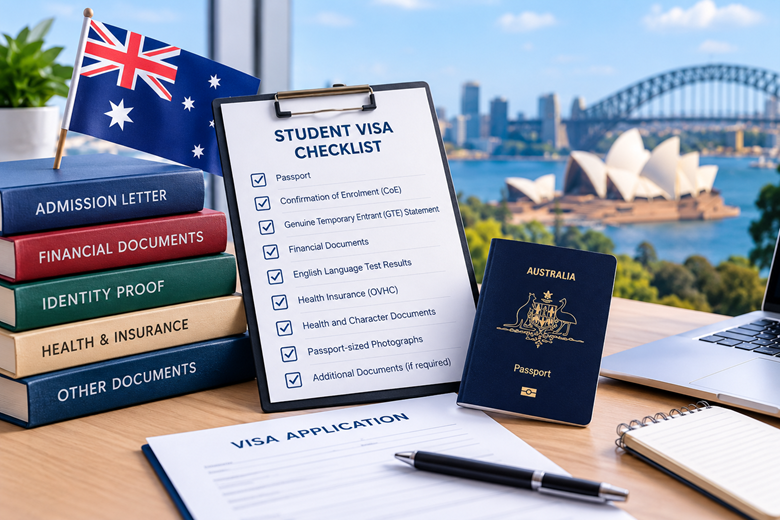
So use this checklist to make everything match, not just to tick boxes. Requirements change by country, course and provider, so run the official Home Affairs document checklist tool before you lodge. Think of this page as the practical side of that tool.
Passport and ID
Scan the photo page flat and clear. Check the expiry date, because a passport that dies halfway through your course means renewing it from overseas, which nobody enjoys. Bringing a partner or children? Their passports go in too.
Name spelled differently on two documents? Attach whatever explains it. Marriage certificate, usually. Some countries also want a national ID or birth certificate.
The CoE (not the offer letter)
Students mix these up all the time. The offer letter is not your Confirmation of Enrolment. You only get the CoE after accepting and meeting conditions, which normally means paying a deposit.
When it arrives, read it slowly. Course name, start date, duration, provider. If any of those differ from your application, fix it now, not after lodging.
Health cover and English
Most people need OSHC for the full visa period. Ask your provider to arrange it while they issue your CoE. Easiest way. Keep the certificate.
For English, you’d usually submit IELTS, PTE, TOEFL iBT or Cambridge. Some applicants are exempt thanks to earlier study in English. Watch the expiry date on your result, and check it against your lodgement day, not your test day.
Evidence behind your Genuine Student answers
Your statement is a claim. Your documents are the proof. Transcripts, an employment letter, payslips, and printed pages from the provider’s site showing the subjects you’ll actually study.
Career change or study break? Explain it plainly and attach something that backs it up. Haven’t written your answers yet? Read our guide to the Genuine Student requirement (link to your GS article) first. You’ll pick better documents once you know what you’re claiming.
Money
Tuition, living costs, travel: you need to show you can cover them. Bank statements are the standard. Loan approvals, scholarship letters, tax returns and business records also count.
If family is paying, add their ID, proof of relationship and their financial records. Then write a short note saying whose money it is, where it came from, and why it’s funding your study. Honestly, this is the step that gets skipped most, and in my view it causes more trouble than anything else on this list.
[Insert a short, real, anonymised example from your own cases here.]
Study and work history
Transcripts and completion certificates should show the institution’s name and the qualification you were awarded. Not in English? Certified translation, uploaded next to the original.
Ask your employer for a letter covering your role, dates and main duties. Payslips help. Self-employed people should bring registration papers and tax filings.
Then compare the lot against your form. Titles, dates, everything. Boring, yes. Also the step that rescues applications.
Studied in Australia before?
Find the old CoEs, transcripts and visa grant notices. Withdrew, transferred or took a break? Have the records and an honest reason ready. Home Affairs looks at your progress and provider changes, and the reason matters. A course that didn’t offer your specialisation is a different story from a family emergency, so say which one it was.
Health and police checks
You may need a health exam or police certificates from countries you’ve lived in. They often tell you after lodging, but start early. Police certificates can take weeks, sometimes longer.
Keeping track
Make a spreadsheet with three columns: the claim, the document that proves it, and a notes column. “Three years as marketing executive” in the first, employment letter in the second. Empty cell in the second column? That’s a gap, and you’ve caught it before the assessor did.
File names count too. “Bank_Statement_Jan2026.pdf” tells the reader what they’re opening. “scan_final2.pdf” doesn’t. Check every page is readable and keep copies of everything.
Mistakes we keep seeing
- Documents that contradict the statement
- Bank statements with no explanation of ownership
- Gaps nobody mentions
- Expired English results
- Cropped or blurry scans
- Someone else’s checklist, copied without checking it fits
Getting help
Had a refusal? Switched courses a few times? Funded by an unusual source? Speak to a registered migration agent before lodging. Even a short review can show which documents carry weight.
If none of that applies, work through the list, check it against the official requirements, and read your answers and documents together one last time. If the story holds, lodge.


